By Ken Bianchi March 16, 2026
Businesses across Indiana increasingly accept credit cards for invoices, especially when dealing with corporate customers. It has become common for businesses to pay other businesses through corporate or purchasing cards due to accounting benefits. However, it has been realized that regular credit card processing involves high interchange fees, which negatively impact business profitability.
To resolve this problem in business-to-business transactions, Level 2 and 3 card processing were introduced. The two card processing levels allow merchants to enjoy low interchange fees when dealing with commercial credit cards. It is essential to understand how to apply level 2 and 3 credit card processing to save businesses in Indiana money while making it easy to deal with corporate clients.
Table of Contents
What Level 2 Card Processing Means
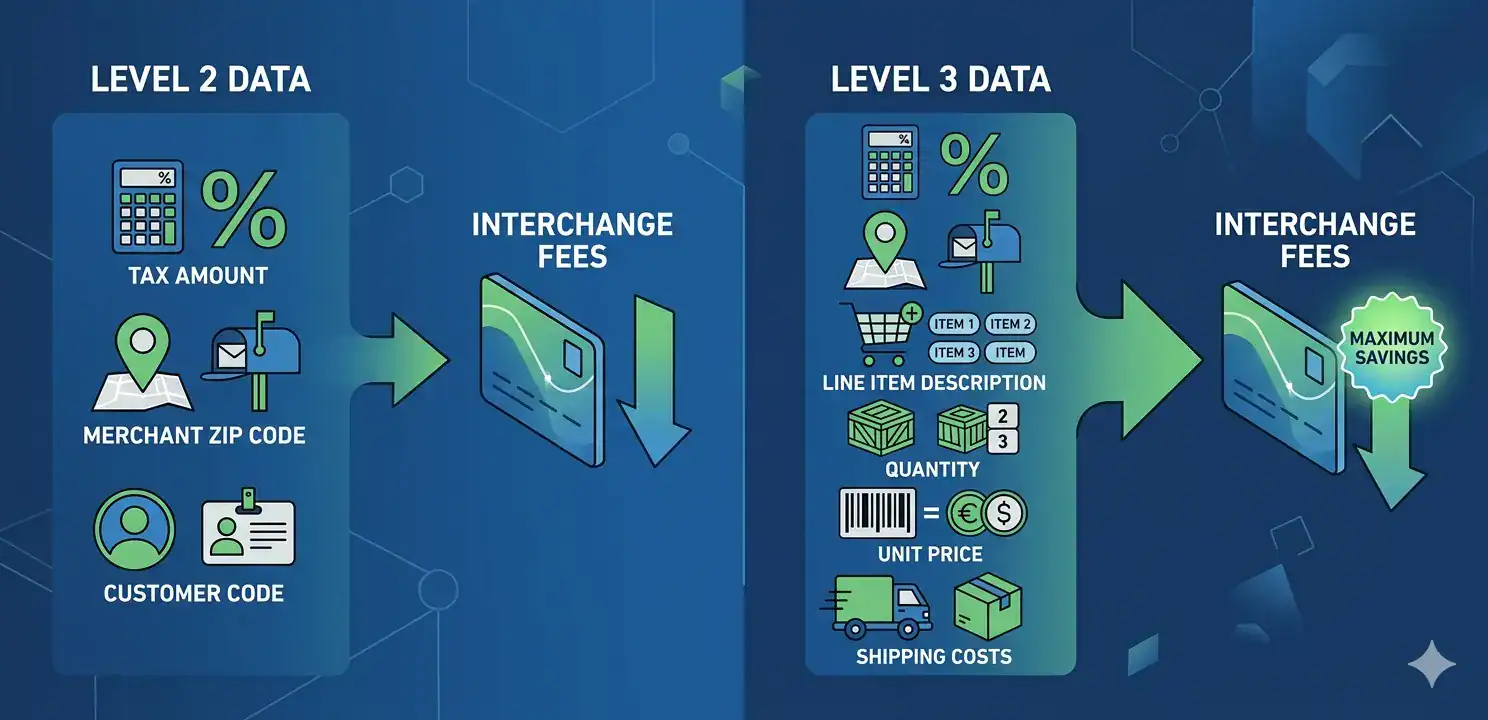
The Level 2 card processing is primarily designed to cater to transactions that involve corporate credit card usage. In addition to the basic payment information that is required in the standard payment transaction, Level 2 card transactions also require additional information such as tax, merchant code, and customer code.
This information enables the card associations to understand the nature of the transaction, thus enabling proper classification of the transaction. If the required information is provided, the merchant can benefit from reduced interchange rates that are lower than those of card-not-present transactions.
Many B2B companies that bill government institutions, large companies, and institutions that use corporate cards can benefit from the Level 2 card processing. Many business organizations in Indiana that bill commercial institutions can benefit from the cost savings that the Level 2 card processing has to offer.
Understanding Level 3 Card Processing
Level 3 card processing is an extension of level 2 card processing in that it provides specific details relating to individual transactions. Apart from providing details relating to taxes and customers, level 3 card transactions can include details relating to product descriptions, quantities of products purchased, shipping costs, and freight charges.
Providing such details is important for the purchasing department in that it makes tracking costs much simpler. In turn, card associations reward merchants for providing level 3 details for card transactions involving purchasing cards with even lower interchange rates. Industries where level 3 card processing is most common include those that have high purchase orders. Such businesses include suppliers, wholesalers, and service contractors.
Why Corporate Cards Require Extra Data
Corporate cards and purchasing cards are popular tools for businesses to keep a check on their employees’ spending. Corporate cards and purchasing cards usually involve a higher level of transactional records compared to consumer credit cards.
Purchasing departments use line-item data to keep a record of all their purchases in different departments or projects. When merchants provide additional transactional data, they are actually helping corporate accounting systems automatically code their transactions.
Merchants are also rewarded by card associations for lower fraud and increased transparency. They reduce interchange rates for merchants who frequently invoice businesses or governments. Such businesses can greatly benefit from these requirements by keeping their payment systems in sync.
Interchange Savings with Level 2 and Level 3 Processing
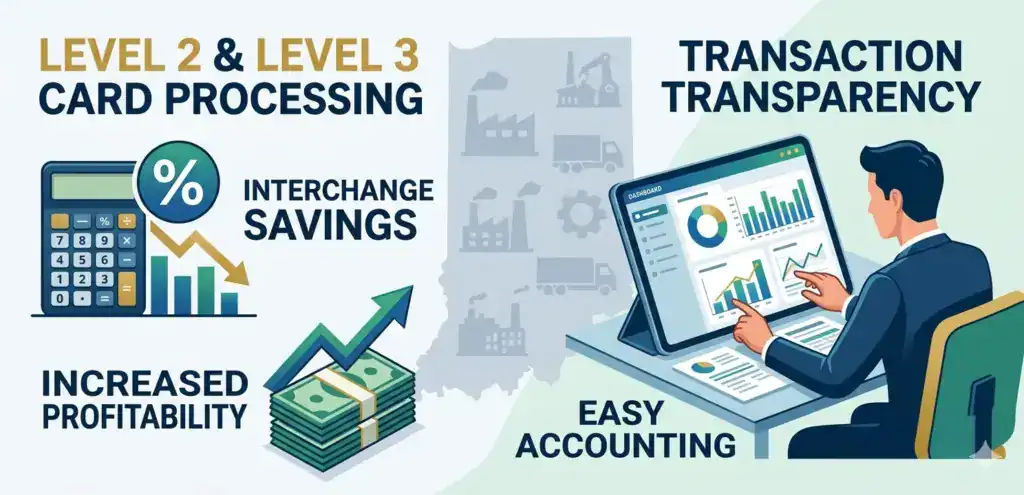
One of the primary advantages of the improvement in data processing is the possibility of interchange savings. The interchange rates for standard card transactions tend to be higher since there is limited context for the transaction. By providing additional information, businesses can use Level 2 and Level 3 processing, which allows the card network to better determine the validity of the transaction.
This level of clarity enables the card network to provide lower interchange rates for commercial card transactions. For businesses within Indiana that deal with corporate card transactions, the possibility of such interchange savings can greatly benefit their bottom line.
When Level 2 Processing Is the Right Choice
Level 2 processing can be used for many B2B transactions when line-item information is not required. Some businesses, such as service providers or consultants, may invoice a company for services instead of products.
In these cases, providing tax information, a zip code of the merchant, and a reference code for the customer can be enough to enable a Level 2 transaction and receive a higher rate. The implementation of a Level 2 solution can be easier than a Level 3 solution because fewer data fields are required.
Many payment gateways and processors can enable a Level 2 transaction with minimal configuration. Businesses looking to reduce costs by a moderate percentage without having to change their invoicing systems can utilize a Level 2 solution.
When Level 3 Processing Becomes Valuable
Level 3 processing is most valuable when there are multiple products or detailed purchase orders included on the invoice. Wholesalers, distributors, and equipment suppliers may have large orders that are being shipped to corporate buyers, and providing line-item data allows the buyer to reconcile the invoice and track the cost of procurement.
Since this type of data improves the transparency of the transaction, card networks reward merchants with lower interchange rates for purchasing card transactions. The cost of implementing Level 3 processing usually requires a more advanced payment system that is capable of transmitting detailed transaction data.
Commercial Card Payments in Indiana
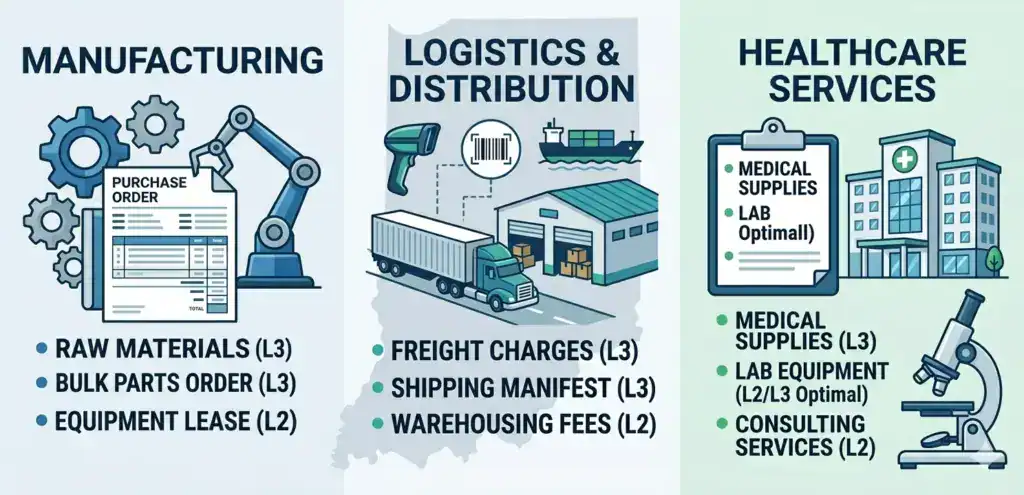
Businesses in Indiana, such as those in manufacturing, logistics, and healthcare, among other service industries, are likely to conduct corporate card transactions. In many cases, these transactions are conducted through invoicing systems rather than traditional payment terminals.
As purchasing cards continue to gain popularity in corporate procurement, vendors must be willing to make the necessary adjustments to accommodate this payment type. Vendors that are capable of processing Level 2 and Level 3 transactions are likely to gain a competitive advantage in the market, especially in Indiana, because this allows them to simplify the payment process for corporate buyers.
By doing so, vendors are likely to enhance a positive business relationship and expedite payment processing. Indiana-based companies that process large invoices should consider upgrading their payment systems to accommodate better transaction data, not only because it is cost-effective but because it is a necessity in today’s B2B payment systems.
Technology Requirements for Enhanced Processing
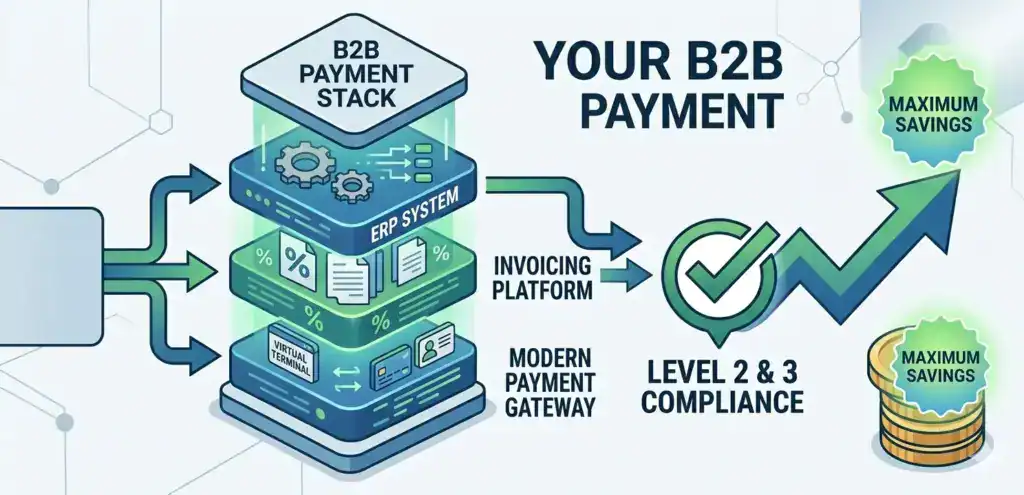
To implement Level 2 or Level 3 card processing, it is necessary to have payment systems that can handle the additional data fields required for the transaction. Many modern payment gateways, invoicing systems, and enterprise resource planning systems can facilitate such features.
It is also necessary for the business to ensure that the invoice information is correctly integrated into the payment processor to facilitate the transmission of tax amounts, product names, and other necessary fields required for the transaction.
If not correctly integrated, the transaction may be processed as a higher-cost transaction. Many payment companies offer special solutions for B2B merchants that can facilitate such integrations. It is necessary to choose the right payment technology partner to ensure the proper functionality of Level 2/3 card processing for all business card transactions.
Improving Invoice Payments with Commercial Cards
By accepting commercial card payments, businesses can greatly speed up their payment cycles as B2B vendors. This is especially true since, instead of waiting for weeks for their clients to pay their dues, businesses can immediately receive payment after processing the transaction. This can greatly benefit their financial condition since it can be easier to manage their accounts payable.
Moreover, businesses can accept corporate card payments while minimizing transaction costs by availing Level 2 or 3 processing levels. Many businesses also include card payment options on their digital invoices, making it easier for clients to pay their dues on time. For Indiana businesses, accepting commercial card payments can be a great way to benefit their operations.
Evaluating Whether Your Business Should Upgrade
Not every business will require a level 2 or 3 processing solution. If a company is a consumer-based business or has a high volume of smaller transactions, it may not realize a great deal of value by upgrading its data submission process.
However, if a company has a high volume of corporate invoices or government contracts, it can realize a great deal of value by upgrading its systems. By analyzing a company’s payment volume, average invoice value, and percentage of corporate card transactions, a business can determine if a level 2 or 3 solution is appropriate.
If a company has a high percentage of corporate card transactions, it can realize significant savings by implementing a level 2 or 3 solution. By analyzing a company’s payments with a certified payment professional, they can determine how they can optimize their systems.
Conclusion
In the case of Level 2 card processing and Level 3 card processing, the business can greatly enhance the efficiency of B2B payment invoices that are paid through corporate card purchases. The business can reduce the cost of transactions by requesting a lower interchange rate in exchange for the detailed transaction information provided by the card processor.
Level 2 card processing is suitable for service-based invoices that do not require detailed transaction information, but Level 3 card processing can offer better savings when the invoices have multiple line items or purchase order information.
Businesses that frequently accept corporate card payments should consider whether the payment systems can accommodate Level 2 or Level 3 card processing. These systems can greatly enhance the efficiency of payment operations for many B2B sellers.
FAQs
What is Level 2 card processing?
Level 2 processing includes additional transaction data such as tax amount, merchant ZIP code, and customer reference number to qualify for lower interchange rates on corporate cards.
What is Level 3 card processing used for?
Level 3 processing provides detailed line-item information, including product descriptions, quantities, and prices for purchasing card transactions.
Which businesses benefit most from Level 2 and Level 3 processing?
Companies that process large B2B invoices or frequently accept corporate and purchasing card payments benefit the most.
Do Level 2 and Level 3 transactions reduce processing costs?
Yes. When transactions include the required data fields, they may qualify for lower interchange categories.
Do businesses need special software to support Level 3 processing?
Most businesses need payment gateways or invoicing platforms capable of transmitting the required enhanced transaction data.