By Ken Bianchi August 25, 2026
Indiana merchants can owe more than one tax on the same transaction. A restaurant may collect Indiana sales tax plus a local food-and-beverage tax, while a lodging property may collect state sales tax plus a county innkeeper’s tax. In a few locations, an additional local or special tax layer can also affect the transaction.
The accounting problem begins when a POS or property-management system combines those obligations into one generic “Indiana tax” percentage. The customer’s total may appear correct, but the merchant may no longer know how much belongs to Indiana sales tax, a food-and-beverage liability, or an innkeeper’s tax account.
Indiana’s statewide sales tax rate is 7%. Food-and-beverage taxes apply only in adopting counties, municipalities, and certain special jurisdictions. County innkeeper’s tax applies only in counties that have adopted it, generally to qualifying accommodations rented for less than 30 days.
Rates and collection arrangements can change. Indiana DOR itself cautions that county innkeeper’s rates may change before DOR’s table is updated and recommends confirming the rate with the county.
Therefore, every rate and jurisdiction in this guide should be checked against the Indiana DOR county tax map, the appropriate county, and current law immediately before configuration or publication.
Indiana Sales Tax vs. Food-and-Beverage and Innkeeper’s Taxes
Indiana sales tax, food-and-beverage tax, and county innkeeper’s tax are separate liabilities even when they apply to the same transaction.
Indiana sales tax is a statewide tax imposed at 7% on taxable retail transactions, including taxable restaurant sales and taxable short-term accommodations.
A food-and-beverage tax, commonly called FAB, is a local excise tax imposed only by jurisdictions authorized to adopt it. County innkeeper’s tax, or CIT, is imposed by adopting counties on qualifying accommodations and is collected in addition to applicable state sales tax.
That distinction matters inside a POS. A restaurant in a jurisdiction with a 1% FAB tax should not simply create an 8% “sales tax” code. It normally needs a 7% Indiana sales-tax code and a separate 1% food-and-beverage code attached to transactions subject to both taxes.
Likewise, a hotel in a county with an 8% innkeeper’s tax should not create a single 15% lodging tax. The PMS should retain the state and county obligations independently.
| Tax | Typical transaction | Geographic basis | Administered/reported to |
| Indiana sales tax | Taxable meals, prepared food, beverages, accommodations and other taxable retail transactions | Statewide | Indiana Department of Revenue |
| Food-and-beverage tax | Qualifying prepared or served food and beverages | Adopting county, municipality or special jurisdiction | Indiana DOR through INTIME under current FAB administration |
| County innkeeper’s tax | Qualifying short-term accommodations | Adopting county | Indiana DOR or county treasurer, depending on collection point |
| Special lodging/FAB tax | Limited statutorily designated transactions | Specific special jurisdiction | Authority identified by governing statute/DOR |
Indiana DOR’s current food-and-beverage page instructs businesses to file and pay FAB through INTIME. County innkeeper’s tax differs: some counties use DOR as the collection point, while others require payment to the county. Marketplace facilitators remit CIT to DOR even when a county otherwise collects locally.
How Indiana Food-and-Beverage Taxes Work
Indiana food-and-beverage tax applies only in jurisdictions that have adopted an authorized tax. It is not a statewide restaurant tax, and not every restaurant sale everywhere in Indiana receives an extra local percentage.
Indiana DOR’s General Tax Information Bulletin #203 explains that FAB generally applies to transactions in which food or beverages are furnished, prepared, or served for consumption at a location or on equipment provided by the retail merchant.
The definition covers common prepared-food situations such as heated food, food prepared from multiple ingredients, catering, and food provided with eating utensils.
The local tax is generally 1%, although there are important exceptions. Some customers inside a municipality can be subject to both a county tax and a municipal tax, producing a 2% combined FAB obligation.
Marion County itself imposes 2%, Shipshewana currently imposes 2%, and a separate 2% FAB applies to transactions within the designated Orange County historic hotel jurisdiction.
Food-and-beverage tax should therefore be evaluated independently from the 7% state rate:
Restaurant location → Is the transaction taxable prepared/served food? → Does a county FAB apply? → Does a municipal FAB also apply?
Catering requires additional attention. Indiana DOR says catering FAB is sourced to where the catering is provided rather than the caterer’s headquarters. A caterer may therefore need different tax profiles for events in different counties and municipalities.
Marketplace-facilitated restaurant sales use a different FAB sourcing rule. DOR states that when FAB is collected by a marketplace facilitator, it is sourced to the retail merchant location where the food was prepared, even when delivery occurs outside the adopting jurisdiction.
Which Indiana Jurisdictions Charge Food-and-Beverage Tax?
The following table reflects the Indiana DOR rate table effective for transactions as of the date this article was prepared. Importantly, DOR also lists Lagro at 1% effective September 1, 2026. Because that date had not yet arrived when this guide was prepared, Lagro is shown separately as a scheduled change rather than a currently effective tax.
| County/Jurisdiction | Current FAB rate | Geographic note |
| Allen County | 1% | Countywide; municipal New Haven tax may also apply |
| Avon | 1% | Municipal |
| Attica | 1% | Municipal |
| Boone County | 1% | Countywide; certain municipalities add another 1% |
| Brownsburg | 1% | Municipal |
| Carmel | 1% | Municipal, in addition to Hamilton County |
| Cicero | 1% | Municipal, in Hamilton County |
| Cloverdale | 1% | Municipal |
| Columbia City | 1% | Municipal |
| Danville | 1% | Municipal |
| Delaware County | 1% | Countywide |
| Fishers | 1% | Municipal, in addition to Hamilton County |
| Greenwood | 1% | Municipal, in addition to Johnson County |
| Hamilton County | 1% | Countywide |
| Hammond | 1% | Municipal |
| Hancock County | 1% | Countywide |
| Hendricks County | 1% | Countywide |
| Henry County | 1% | Countywide |
| Jasper | 1% | Municipal |
| Johnson County | 1% | Countywide |
| Lebanon | 1% | Municipal, in addition to Boone County |
| Madison | 1% | Municipal, in addition to Madison County |
| Madison County | 1% | Countywide |
| Marion | 1% | City of Marion |
| Marion County | 2% | Countywide |
| Martinsville | 1% | Municipal |
| Merrillville | 1% | Municipal |
| Monroe County | 1% | Countywide |
| Mooresville | 1% | Municipal |
| Nashville | 1% | Municipal |
| New Haven | 1% | Municipal, in addition to Allen County |
| Noblesville | 1% | Municipal, in addition to Hamilton County |
| Orange County | 1% | Countywide |
| Orange County Historic Hotel | 2% | Special designated jurisdiction; confirm interaction with county FAB |
| Plainfield | 1% | Municipal |
| Richmond | 1% | Municipal |
| Rockville | 1% | Municipal |
| Shelby County | 1% | Countywide |
| Shipshewana | 2% | Municipal |
| Vanderburgh County | 1% | Countywide |
| Vigo County | 1% | Countywide |
| Westfield | 1% | Municipal, in addition to Hamilton County |
| Whitestown | 1% | Municipal, in addition to Boone County |
| Zionsville | 1% | Municipal, in addition to Boone County |
Source and effective-date details are maintained on the Indiana DOR Food & Beverage Tax page.
The overlap is one reason Indiana POS sales-tax setup must be location-specific. A restaurant in Hamilton County but outside an adopting municipality may have a 1% FAB obligation, while a qualifying transaction in Carmel, Fishers, Noblesville, or Westfield may have the county 1% plus that municipality’s 1%.
Never copy a tax profile solely because two stores are in the same county.
Indiana County Innkeeper’s Tax and Which Counties Charge It
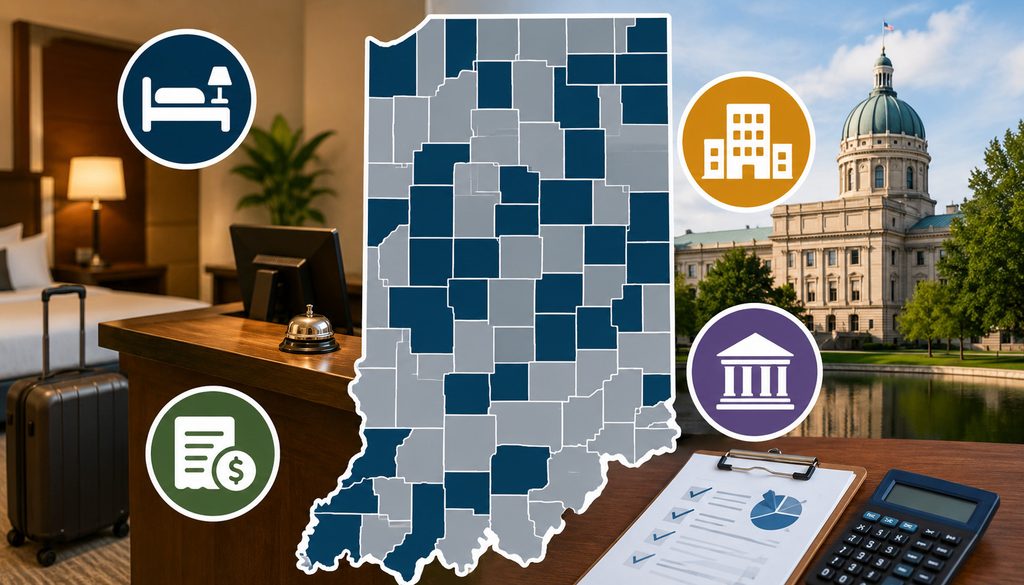
County innkeeper’s tax is imposed on qualifying rentals of rooms and accommodations in adopting Indiana counties. DOR describes it as a county tax on accommodations rented for periods of less than 30 days, imposed in addition to state sales tax.
Covered accommodations can extend beyond traditional hotels and motels. Depending on the governing statute and ordinance, DOR identifies hotels, vacation homes, bed-and-breakfast establishments, cabins, cottages, campsites, houseboats, camper spaces, certain banquet facilities and other accommodations as potentially covered.
An accommodation rented for 30 consecutive days or more generally qualifies for the sales-tax exemption described in DOR Sales Tax Information Bulletin #41. If the guest is initially billed for shorter periods but ultimately stays 30 consecutive days, special refund rules can apply.
The POS or PMS therefore needs more than a simple “room=yes/no” rule. It needs to distinguish taxable short stays, qualifying extended stays, exempt customers where supported, marketplace bookings, and non-room revenue.
Current County Innkeeper’s Tax Rates
The following counties appear on Indiana DOR’s CIT table. “State” means DOR is the collection point; “County” means the county generally collects directly.
One important correction is Wells County: DOR’s main table currently displays a blank present-rate field, but the official Wells County Treasurer states that its ordinance imposes a 5% tax and requires monthly filing with the county.
DeKalb is another timing issue. DOR lists 8% effective November 1, 2026 and shows 5% as the previous rate. Until that effective date, transactions should continue to be tested against the currently effective 5% rate rather than prematurely using 8%.
| County | Rate currently effective | Collection point |
| Allen | 8% | State |
| Bartholomew | 5% | County |
| Boone | 8% | County |
| Brown | 8% | State |
| Carroll | 5% | County |
| Cass | 3.5% | County |
| Clark | 6% | State |
| Clinton | 4% | County |
| Crawford | 5% | County |
| Daviess | 9% | County |
| Dearborn | 5% | State |
| Decatur | 5% | County |
| DeKalb | 5% | County; 8% scheduled November 1, 2026 |
| Delaware | 5% | County |
| Dubois | 5% | State |
| Elkhart | 5% | County |
| Fayette | 5% | County |
| Floyd | 6% | State |
| Franklin | 5% | State |
| Fulton | 5% | County |
| Gibson | 5% | County |
| Grant | 5% | County |
| Greene | 5% | County |
| Hamilton | 8% | County |
| Hancock | 5% | County |
| Harrison | 4% | County |
| Hendricks | 8% | County |
| Henry | 5% | County |
| Howard | 8% | County |
| Huntington | 5% | County |
| Jackson | 5% | County |
| Jasper | 5% | County |
| Jay | 5% | County |
| Jefferson | 8% | County |
| Jennings | 5% | County |
| Johnson | 5% | County |
| Knox | 8% | County |
| Kosciusko | 5% | County |
| LaGrange | 8% | State |
| Lake | 5% | County |
| LaPorte | 5% | County |
| Lawrence | 5% | County |
| Madison | 5% | County |
| Marion | 10% | State |
| Marshall | 5% | State |
| Martin | 5% | State |
| Miami | 5% | County |
| Monroe | 5% | County |
| Montgomery | 3% | County |
| Morgan | 5% | County |
| Noble | 5% | County |
| Ohio | 5% | County |
| Orange | 4% | County |
| Orange Historic Hotels Supplemental | 2% | State |
| Owen | 5% | State |
| Parke | 8% | County |
| Perry | 5% | County |
| Pike | 5% | State |
| Porter | 5% | County |
| Posey | 5% | County |
| Putnam | 5% | County |
| Randolph | 5% | County |
| Ripley | 5% | County |
| St. Joseph | 8% | County |
| Scott | 5% | State |
| Shelby | 5% | State |
| Spencer | 5% | County |
| Starke | 5% | County |
| Steuben | 5% | County |
| Sullivan | 5% | County |
| Switzerland | 5% | County |
| Tippecanoe | 5% | County |
| Union | 5% | County |
| Vanderburgh | 8% | County |
| Vermillion | 5% | State |
| Vigo | 8% | County |
| Wabash | 5% | County |
| Warrick | 5% | State |
| Washington | 5% | County |
| Wayne | 5% | County |
| Wells | 5% | County |
| White | 5% | County |
The primary statewide reference is the Indiana DOR County Innkeeper’s Tax page. DOR expressly states that its table relies on information supplied by county auditors and recommends contacting the county for the most current rate.
Counties not appearing in DOR’s current adopting-county table should not automatically be configured with CIT. Before opening a new property, however, verify the county auditor’s office because newly authorized taxes or rate changes can take effect after system documentation was prepared.
County vs. Special Lodging Taxes and Hotel PMS Configuration
For most Indiana lodging operators, the starting formula is:
Taxable Room Charge → 7% Indiana Sales Tax + Applicable County Innkeeper’s Tax
The challenge is determining exactly what belongs in the “taxable room charge” and whether another statutorily created tax applies. Orange County, for example, has a separately listed 2% historical-hotels supplemental innkeeper’s tax. A property subject to a special provision should not assume the standard county rate is the only local tax.
Indiana DOR’s accommodation bulletin also makes the 30-day distinction important. Accommodations rented for 30 consecutive days or more are generally exempt from state sales tax, and DOR’s CIT guidance states that transactions exempt from state sales tax are not subject to CIT.
A hotel PMS should therefore maintain tax codes such as:
- Indiana sales tax — room revenue
- County innkeeper’s tax — room/accommodation revenue
- Special supplemental lodging tax — only where legally applicable
- Restaurant sales tax
- Restaurant FAB tax
- Other taxable fees
- Non-taxable or separately analyzed service charges
Do not automatically map parking, resort fees, meeting rooms, banquet charges, pet fees, cancellation charges, or other incidental charges to the room tax profile. Their treatment depends on the nature of the charge and the applicable statute or DOR guidance.
The same hotel can have two different tax systems operating simultaneously. A guest room may generate sales tax and CIT, while a meal in the hotel restaurant may generate sales tax and FAB.
Restaurant POS Tax Configuration and Food Taxability
Configuring Indiana Food-and-Beverage in your POS begins with the underlying Indiana sales-tax treatment. DOR’s current restaurant guidance says restaurants generally collect Indiana sales tax on their sales of prepared food and beverages unless a specific exemption applies.
Indiana generally exempts qualifying grocery-type food and food ingredients, but the exemption does not broadly cover every item people consume. Alcoholic beverages, candy, soft drinks and dietary supplements are excluded from the general grocery-food definition, and prepared-food rules can convert otherwise grocery-type ingredients into taxable restaurant transactions.
Modern restaurant systems can connect ordering, payments, reporting, inventory, and multiple sales channels in one platform. Businesses evaluating these capabilities can also review how restaurant POS systems in Indiana support integrated checkout and reporting, while keeping tax configuration tied to current Indiana tax rules.
A practical restaurant setup uses at least:
Tax Rule 1: Indiana Sales Tax — 7%
Tax Rule 2: County Food-and-Beverage Tax — where applicable
Tax Rule 3: Municipal Food-and-Beverage Tax — where applicable
Each rule should then be assigned to eligible menu categories rather than activated globally.
| POS category | State sales tax | FAB tax | CIT | Notes |
| Dine-in prepared meal | Generally yes | Yes in adopting jurisdiction | No | Typical restaurant transaction |
| Takeout prepared meal | Generally yes | Generally yes when FAB definition applies | No | Takeout alone does not create a blanket FAB exemption |
| Alcoholic beverage | Yes | Can be within applicable FAB base | No | Verify local/FAB treatment |
| Qualifying grocery-type food | Often exempt | Usually outside prepared-food FAB treatment | No | Classification matters |
| Hotel room | Yes if taxable short-term accommodation | No merely because it is a room | Yes in adopting county | Separate lodging tax profile |
| Hotel restaurant meal | Yes | Yes where applicable | No | Keep restaurant and room revenue separate |
| Banquet/catering food | Generally taxable | Depends on event/service jurisdiction | Not merely because food is served | Catering sourcing requires special attention |
DOR’s restaurant guidance states that gratuities voluntarily added through an affirmative customer action are not taxable.
It also states that separately stated mandatory charges for serving food or beverages are not subject to sales tax under the conditions described in the bulletin. Delivery charges, however, can be taxable when they form part of the selling price of taxable prepared food.
Discounts, Coupons, Gift Cards and Refunds
Indiana treats discounts differently depending on who funds them. DOR Bulletin #58 explains that a merchant-funded discount generally reduces gross retail income, while a manufacturer or other third-party reimbursed coupon can remain part of the taxable amount when the statutory conditions are met.
That means the POS should identify promotion type rather than treating every coupon as a generic reduction.
Gift-card sales generally represent the purchase of a payment instrument rather than the underlying taxable food or lodging. The taxable event ordinarily occurs when the card is redeemed for the taxable transaction. POS reporting should therefore avoid treating the original gift-card load as taxable sales revenue and then taxing the redemption again.
Refunds should reverse the appropriate revenue and associated tax codes. A refunded restaurant transaction that originally generated state sales tax plus FAB should not reverse only the state component.
Same-day voids may disappear before settlement, while post-settlement refunds appear as later-period adjustments. Tax reporting should follow the actual transaction history and maintain enough detail to connect the refund to the original taxes.
Catering, Delivery, Marketplaces and Third-Party Platforms
Catering is one of the easiest places to misconfigure Indiana local tax because FAB sourcing does not always follow the caterer’s store address.
Indiana DOR says catering FAB is sourced to the location where the catering is provided. A caterer based in a non-FAB county can therefore have a FAB obligation when catering an event inside an adopting jurisdiction. Conversely, a caterer headquartered in a FAB jurisdiction does not necessarily apply its home tax to an event performed elsewhere.
A catering POS should capture at least:
- event address;
- county;
- municipality;
- service date;
- applicable state tax;
- applicable county FAB;
- applicable municipal FAB;
- taxable delivery or other charges; and
- source used to determine the rate.
Marketplace orders need another workflow. Indiana requires marketplace facilitators to collect Indiana sales tax on facilitated taxable sales and says some facilitators must also collect FAB and CIT. For marketplace-facilitated food transactions, FAB is sourced to the merchant location where the food was prepared.
For lodging, DOR states that marketplace facilitators must collect and remit applicable state sales tax and county innkeeper’s tax on behalf of sellers. Marketplace-facilitator CIT is remitted to DOR even if the county normally self-collects CIT.
Restaurants and hotels should still reconcile marketplace activity. Do not assume “the platform handled tax” without checking:
- which taxes the platform collected;
- what taxable base it used;
- which jurisdiction it assigned;
- whether the tax was remitted by the platform;
- whether the merchant’s tax return requires marketplace sales to be reported as gross sales, deductions, informational amounts, or another category.
Multi-Location Indiana POS Tax Configuration
Multi-location operators should never build one Indiana tax template and copy it blindly across all stores or properties. The combination of county FAB, municipal FAB, county innkeeper’s tax, special taxes and different collection authorities makes location-specific configuration essential.
The underlying POS architecture also matters when locations need different tax, reporting, payment, or operational settings. This guide to POS and credit-card terminal setup for multi-location Indiana businesses provides additional context on choosing systems that can support centralized management without eliminating location-level controls.
Maintain a tax matrix similar to this:
| Location | County | Municipality | State sales tax | FAB | CIT | Effective date |
| Restaurant A | Verified county | Verified city/town | 7% | Verified | N/A | Source date |
| Restaurant B | Verified county | Verified city/town | 7% | Verified | N/A | Source date |
| Hotel A | Verified county | Verified municipality | 7% | Restaurant component if applicable | Verified | Source date |
| Hotel B | Verified county | Verified municipality | 7% | Restaurant component if applicable | Verified | Source date |
The operational hierarchy should be:
Store/Property Location → Tax Jurisdiction → Product/Revenue Category → Applicable Tax Codes
That hierarchy is particularly important in counties where a municipality adds FAB on top of a county tax. A Hamilton County restaurant in Carmel and a Hamilton County restaurant outside an adopting municipality should not automatically share the same FAB profile.
New Location Setup
Before the first live sale at a new location:
- Verify the physical street address.
- Confirm the county and incorporated municipality.
- Check Indiana DOR’s county tax map.
- Check the dedicated FAB and CIT rate pages.
- Confirm any recent ordinance or rate change with the local authority.
- Determine taxable menu, lodging and fee categories.
- Create separate tax codes.
- Set effective dates.
- Test taxable, exempt, discounted and refunded transactions.
- Verify receipt presentation and tax-liability reporting.
- Save the official source and approval documentation.
A new tax rate should normally be added with an effective date rather than overwriting historic data. Historical transactions should continue to show the tax actually charged at the time of sale.
This matters when rates are scheduled in advance. DOR currently shows Lagro’s 1% FAB effective September 1, 2026 and DeKalb County’s 8% CIT effective November 1, 2026. Systems should activate those changes on the legally effective date, not when the future rate first appears on a reference table.
Tax-Inclusive Pricing, Rounding, Exemptions and Special Transactions
Tax-inclusive pricing should not be enabled merely because the POS supports it. A merchant must ensure the pricing and receipt method satisfies Indiana requirements and still allows the accounting system to identify the tax portion correctly.
The same caution applies to rounding. Indiana DOR provides tax charts, including ST-107 and food-and-beverage charts, but a POS should follow the applicable state calculation method and system requirements rather than use an invented “round up” or “round down” policy.
Exempt transactions also require careful separation. DOR states that transactions exempt from state sales tax are not subject to county innkeeper’s tax, but exemption documentation and eligibility must still be tested under the relevant rule.
For restaurants, tax-exempt purchases by government or nonprofit entities can have specific requirements regarding who is invoiced and who pays. Do not grant exemption simply because an employee presents an organization’s name or business card. Indiana DOR maintains specific exemption forms and nonprofit procedures.
Complimentary rooms and meals should also be reviewed before assigning an automatic zero-tax treatment. “No customer payment” does not by itself answer every sales/use-tax issue, especially when complimentary items are tied to packages, promotions, loyalty programs, employee benefits, or other considerations.
Service charges deserve their own POS category. Indiana restaurant guidance distinguishes voluntary gratuities, separately stated service charges and delivery charges. Hotel fees can raise different questions under accommodation rules.
Do not configure them all as either “taxable” or “non-taxable” merely because they appear below the subtotal.
Why Separate POS Tax Codes Matter
Separate codes create an audit trail from the original transaction to the tax return.
Consider a qualifying restaurant transaction in a location where the state rate is 7%, county FAB is 1%, and municipal FAB is another 1%. The customer effectively experiences 9% in tax, but the merchant has three liabilities:
- Indiana sales tax payable;
- county FAB payable;
- municipal FAB payable.
If the POS records only “Tax = 9%,” the operator may know the total but not the amount to report under each account. Refunds, exemptions, rate changes and accounting adjustments become especially difficult.
A separate-code configuration supports:
- accurate tax-liability reports;
- easier GL mapping;
- local rate updates;
- location-by-location controls;
- clearer refund reversals;
- marketplace reconciliation;
- separate return preparation; and
- better audit support.
A useful restaurant calculation looks like this:
Illustrative taxable food sale: $100
Indiana sales tax: $100 × 7% = $7
Illustrative local FAB: $100 × 1% = $1
Customer total: $108
The example uses 1% only as an illustration. The merchant must insert the verified local rate and any additional municipal tax applicable to the actual location.
A hotel example works similarly. If a $200 room is subject to the statewide 7% sales tax and a verified 5% county innkeeper’s tax:
State sales tax: $14
County innkeeper’s tax: $10
Total taxes: $24
The PMS should retain the $14 and $10 as separate liabilities even though the guest sees $24 in total tax.
For broader payment-system considerations, an Indiana merchant evaluating POS architecture can also review this discussion of credit-card and digital-payment systems for small businesses, particularly when deciding how payment channels and POS reporting should integrate. Tax rules, however, must still come from Indiana and local authorities.
POS Tax Reports, General Ledger Mapping and Reconciliation
A tax return should not be prepared solely from the total tax figure printed on a payment-processor statement. Processor deposits measure money movement. Tax returns are based on taxable transactions, deductions, exemptions and adjustments.
Reliable reconciliation also depends on the POS retaining detailed transaction and category-level sales information. Businesses can review how modern checkout systems help Indiana retailers track sales and operational data for additional background on real-time reporting and integrated transaction records.
Suggested restaurant reporting fields include:
| Date | Location | Taxable FAB sales | FAB collected | Refunds/adjustments | Net liability |
| Daily detail | Store | Amount | Amount | Amount | Amount |
For lodging:
| Date | Property | Taxable lodging | County CIT | Special tax | Adjustments |
| Daily detail | Hotel | Amount | Amount | Amount | Amount |
The general ledger should normally contain separate accounts such as:
- Indiana sales tax payable;
- food-and-beverage tax payable;
- county innkeeper’s tax payable;
- special lodging tax payable.
Do not post taxes collected as operating sales revenue.
Daily reconciliation should connect the transaction system to payments:
POS Gross Sales → Tax → Tender Totals → Processor Settlement → Bank
Monthly tax reconciliation adds the GL and return:
- Export the tax-liability report.
- Reconcile taxable sales to revenue accounts.
- Review refunds and voids.
- Review exempt transactions.
- Reconcile marketplace sales separately.
- Compare tax collected by code with tax computed for the return.
- Investigate variances before filing.
- Save the filed return and payment confirmation.
A difference between tax collected and tax owed is a warning sign. Undercollection does not necessarily eliminate the merchant’s obligation, while excess amounts collected as tax should not casually be treated as revenue. Material errors should be reviewed with Indiana DOR, the local authority and a qualified tax professional.
Reporting Indiana Food-and-Beverage and County Innkeeper’s Taxes
Indiana DOR currently instructs FAB taxpayers to file and pay food-and-beverage tax through INTIME. Businesses that sell food in adopting jurisdictions must register for the appropriate FAB accounts, and DOR says previously registered trust-tax filers must file zero-dollar returns when no activity occurs for a required period.
Use the Indiana DOR Food & Beverage Tax guidance to confirm jurisdiction codes, current rates and filing instructions.
County innkeeper’s tax is different because the collection point varies. If the DOR table identifies “State,” the taxpayer generally registers and remits through Indiana’s state system.
If it identifies “County,” CIT is remitted locally using the county-approved return. DOR states that county-collected CIT must be paid monthly and reported on forms approved by the county treasurer.
DOR also states that a retail merchant with annual CIT collections below $1,000 is required to file a return annually when the tax is administered by DOR, while marketplace facilitators file monthly CIT returns for adopting counties in which they facilitated accommodations.
Businesses should follow the filing frequency assigned to their actual account rather than assume every CIT account follows one schedule.
The most important reporting rule is therefore:
Do not assume all local taxes go to the same agency.
A multi-county hotel operator may have one property whose CIT is filed through INTIME and another whose CIT return goes directly to a county treasurer.
Businesses registered for trust taxes must also pay attention to zero-return requirements. DOR states that a required FAB or CIT filer may still need to submit a $0 return when there is no taxable activity for the period.
Late-filed trust-tax returns can be subject to penalties, and Indiana separately imposes penalties for failure to pay certain taxes. Current penalty calculations should always be verified before relying on a percentage.
The POS report supports the return; it is not itself the return.
Audits, Tax Configuration Records and Common Mistakes
A strong Indiana POS tax-compliance file shows not only what rate is in the system but why it is there.
Retain:
- detailed POS transactions;
- tax-code configuration;
- effective dates;
- receipts;
- refund and void records;
- exemption certificates;
- marketplace reports;
- taxable-sales summaries;
- filed tax returns;
- payment confirmations;
- GL account detail;
- county forms;
- official rate notices; and
- approval records for configuration changes.
For every tax change, keep an audit log containing:
| Field | Record |
| Tax code | Exact POS/PMS code |
| Previous rate | Old percentage |
| New rate | New percentage |
| Effective date | Legal activation date |
| Source | DOR/county/ordinance |
| Changed by | Administrator |
| Approved by | Controller/manager |
| Test evidence | Receipt/report screenshot |
Common Indiana POS tax mistakes include applying a combined tax code to every sale, copying another county’s rate, failing to account for municipal FAB, prematurely activating a future rate, treating hotel restaurant revenue as room revenue, taxing unrelated hotel fees as CIT without analysis, failing to reverse taxes on refunds, and overlooking marketplace-facilitated sales.
Another common mistake is relying on a downloaded spreadsheet indefinitely. Indiana DOR explicitly warns that CIT information can lag local changes because counties must notify the state.
A practical tax-configuration checklist is:
| Item | Verified? |
| Business address and jurisdiction | |
| Indiana sales tax | |
| Food-and-beverage tax | |
| County innkeeper’s tax | |
| Special lodging/FAB tax | |
| Taxable product categories | |
| Exemptions | |
| Discounts and coupons | |
| Refunds and voids | |
| Marketplace treatment | |
| Tax liability accounts | |
| Effective dates | |
| Reporting authority | |
| Filing frequency | |
| Official source retained |
Before approving a POS or PMS, ask the provider whether tax rules can be assigned by location, whether multiple tax codes can apply to the same transaction, whether old rates remain on historical sales, how refunds reverse taxes, whether exemptions are logged, whether marketplace channels can be separated, and whether restaurant and lodging tax profiles can coexist at one property.
Frequently Asked Questions
Does every Indiana county charge a food-and-beverage tax?
No. Indiana FAB is a local option tax that applies only in jurisdictions that have adopted an authorized tax. Some taxes are countywide, while others apply only in a city or town. Certain municipalities also overlap a county FAB, meaning a qualifying transaction can be subject to both.
Which Indiana counties charge food-and-beverage tax?
Current countywide FAB jurisdictions listed by DOR include Allen, Boone, Delaware, Hamilton, Hancock, Hendricks, Henry, Johnson, Madison, Marion, Monroe, Orange, Shelby, Vanderburgh and Vigo counties. Numerous municipalities also impose FAB. Always verify the DOR rate page immediately before configuring a location.
Which Indiana counties charge innkeeper’s tax?
Most, but not all, Indiana counties currently appear on DOR’s CIT table. Rates range materially by county, and administration may be through DOR or the county. The county-by-county table earlier in this guide identifies the currently listed adopting counties.
Is the county innkeeper’s tax the same as Indiana sales tax?
No. Indiana sales tax is a statewide 7% tax. CIT is a separate county tax imposed only by adopting counties on qualifying accommodations. A taxable hotel stay can therefore generate both liabilities.
Do restaurants collect both sales tax and food-and-beverage tax?
They do when the restaurant sale is taxable and occurs within an adopting FAB jurisdiction. The state tax and local FAB should be configured and reported separately even if both appear in the customer’s total.
Do hotels collect sales tax plus innkeeper’s tax?
Generally, taxable short-term accommodations in an adopting county are subject to both Indiana sales tax and CIT. Special exemptions, extended stays and special statutory taxes can change the result, so the PMS should evaluate the actual transaction.
How should Indiana food-and-beverage tax be configured in a POS?
Create a separate FAB tax code, assign the verified jurisdictional rate, attach it only to qualifying products and the correct locations, and preserve it separately from the Indiana sales-tax code. Where county and municipal FAB overlap, use separate codes for both.
How should innkeeper’s tax be configured in a hotel PMS?
Create a separate county CIT code attached to qualifying accommodation revenue. Keep it separate from the 7% sales-tax code and from restaurant FAB, parking, meeting-room or other fee categories unless those charges have independently been determined to belong in the tax base.
Should local taxes use separate POS tax codes?
Yes. Separate codes improve filing accuracy, refunds, GL mapping, historical rate tracking and audit support. A combined percentage may calculate the customer total correctly while still producing poor accounting records.
How are refunds handled for Indiana local taxes?
A refund should reverse the appropriate tax liabilities associated with the original transaction where legally appropriate. The POS should not reduce revenue but leave the related state or local tax payable balance unchanged.
Does a marketplace collect Indiana FAB or innkeeper’s tax?
Indiana requires marketplace facilitators to collect sales tax on facilitated taxable sales, and qualifying facilitators may also be responsible for FAB or CIT. DOR specifically requires marketplace facilitators of accommodations to remit CIT to DOR.
Where is Indiana food-and-beverage tax reported?
Indiana DOR currently instructs businesses to file and pay FAB through INTIME. Businesses should verify that each applicable county or municipal FAB account has been registered and use the correct jurisdiction code.
Where is the county innkeeper’s tax reported?
It depends on the county. DOR’s CIT table identifies the collection point as either State or County. State-collected CIT is handled through DOR, while county-collected CIT generally uses a county-approved return submitted to the county treasurer.
How should multi-location businesses manage different county rates?
Maintain a tax matrix by physical location, county, municipality, tax code, rate, authority and effective date. Do not copy one store’s profile to another without confirming both county and municipal taxes.
What POS reports should be retained for an Indiana tax audit?
Retain transaction detail, taxable-sales reports, tax-by-code reports, refund and void detail, exemption records, marketplace activity, rate-change history and tax-liability summaries. Those records should reconcile to the GL, filed returns and tax payments.
Conclusion
Configuring Indiana taxes in a POS is not a matter of finding one combined percentage and applying it to every transaction.
The correct workflow starts with the business location and transaction type. Determine whether Indiana sales tax applies, identify any county or municipal food-and-beverage tax, determine whether a lodging transaction is subject to county innkeeper’s tax or a special statutory tax, and then map each obligation to a separate POS or PMS code.
For restaurants, this means distinguishing prepared food from potentially exempt grocery-type items, handling catering sourcing correctly, separating county and municipal FAB, and reconciling marketplace orders.
For hotels, it means separating room revenue from restaurant revenue and other fees, applying CIT only to the appropriate accommodation base, and tracking whether the tax is remitted to Indiana DOR or directly to the county.
Multi-location operators should maintain a location-by-location tax matrix and preserve effective dates rather than overwrite historic rates. The final control should connect POS taxable sales to separate tax liabilities, the general ledger, filed returns and payment confirmations.
Indiana local tax law can change through legislation and local ordinances. Before relying on any rate, exemption, collection point or filing schedule, verify the current information with the Indiana Department of Revenue, the appropriate county or municipality, and a qualified Indiana tax professional.
This article is provided for general informational purposes and is not tax, accounting or legal advice. Merchants should confirm the treatment of their specific transactions, locations and POS configuration with Indiana DOR, the appropriate local taxing authority, and a qualified adviser before collecting, reporting or remitting tax.